

ACADIA Awards of Excellence
Established in 1998, the ACADIA Awards of Excellence honor outstanding contributions to architectural computing. Originally focused on Teaching, Service, and Research, the program has expanded over time to include Digital Practice, Society, and, more recently, the Impact Award, which recognizes innovative educational and community initiatives. Each year, select individuals or programs are recognized for exceptional and innovative achievements that advance the field of digital design.
ACADIA 2026 Innovative Research Award of Excellence
This award recognizes innovative research that contributes to the field of digital design in architecture. The award distinguishes research with the potential to transform contemporary architecture.

Benjamin Dillenburger
Benjamin Dillenburger is an architect whose work connects computational design, artificial intelligence, and digital fabrication to broaden design freedom, working towards a digital building culture of performative, highly differentiated building solutions. He investigates how learning-based and generative methods translate into built form, where geometric richness becomes a means of material economy. Works include Tor Alva, a 3D-printed tower in the Swiss Alps, and a full-scale 3D-printed room in the permanent collection of the Centre Pompidou, Paris; work from his research group, Digital Building Technologies (DBT), has been exhibited at the Venice Architecture Biennale. Dillenburger holds a PhD from ETH Zurich, where he leads DBT at the Institute of Technology in Architecture, following an Assistant Professorship at the University of Toronto. He is a Principal Investigator of the Swiss National Centre of Competence in Research in Digital Fabrication (NCCR DFAB, 2016 to 2026) and co-founder of Design++, ETH Zurich’s centre for augmented computational design in architecture, engineering and construction.
ACADIA 2026 Teaching Award of Excellence
This award recognizes innovative teaching in the field of digital design in architecture.

Jose Luis García del Castillo y López
Teaching Professor, Northeastern Universityt
Jose Luis García del Castillo y López is an architect, computational designer, and educator. In his research, he examines, questions, and reinvents the tools we design with, in order to better understand and enhance human creativity. Bridging design, computer science, and cognitive theories, his work advances human-computer interaction across computational design, digital fabrication, robotics, and AI.
Jose Luis holds a Doctorate in Design from the Harvard Graduate School of Design and is currently a Teaching Professor at Northeastern University, following appointments at Harvard, UPenn, and the Universidad de Sevilla. Alongside his teaching, he serves as PI at the Computational Design & Cognition Laboratory and co-founded ParametricCamp, an open educational project whose free video tutorials have made computational design accessible to tens of thousands of designers, architects, and visual artists. Earlier in his career, he worked as a Research Engineer in Autodesk’s Generative Design Group.
ACADIA Innovative Program Award of Excellence
This award recognizes an innovative academic program that contributes to education and access for students in the field of digital design.
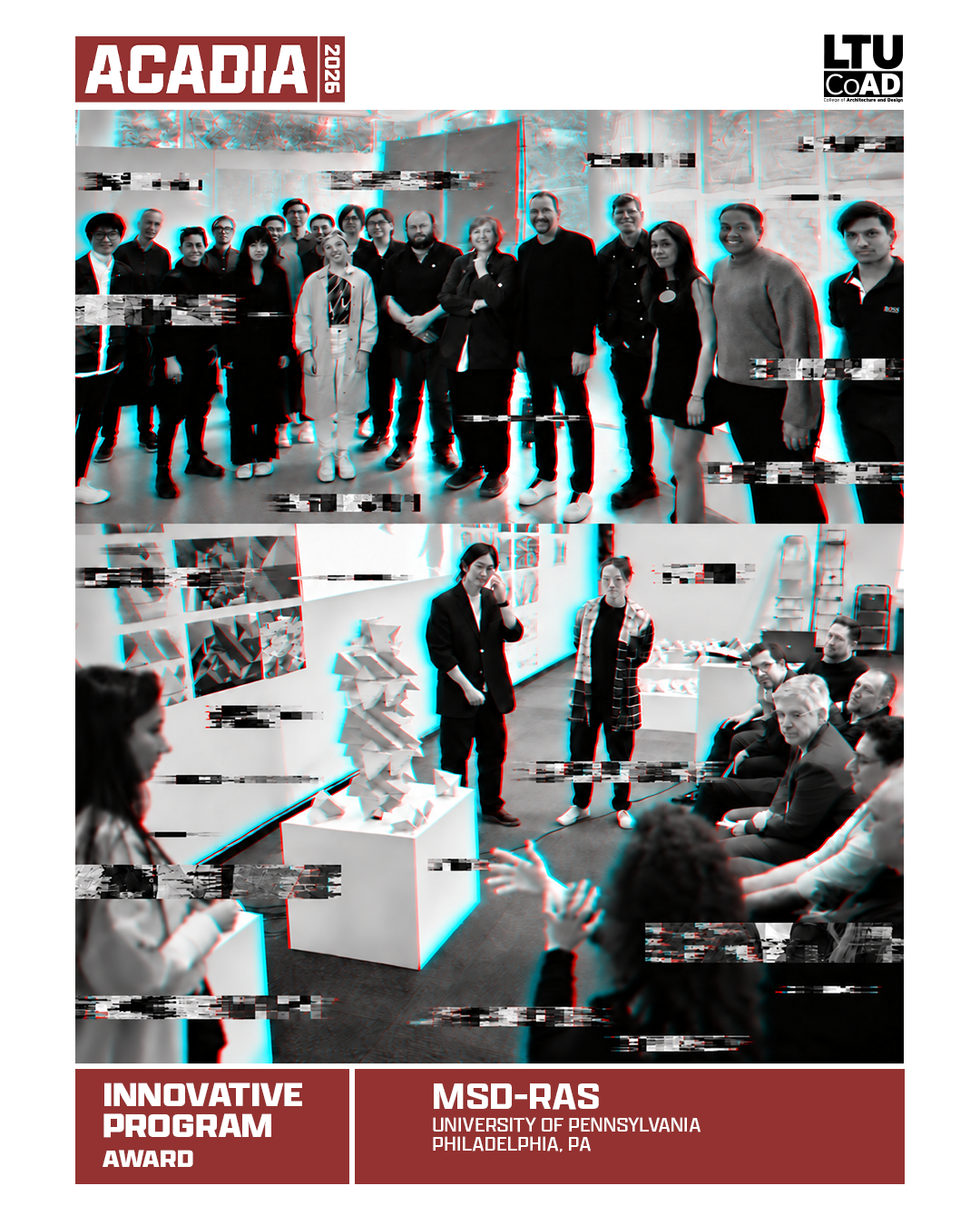
University of Pennsylvania Master of Science in Design: Robotics & Autonomous Systems (MSD-RAS) Representative: Robert-Stuart Smith, Founding Director
Master of Science in Design: Robotics and Autonomous Systems (MSD-RAS)
The pioneering degree integrates AI, autonomous fabrication, and computation within architectural design and is the first post-professional master’s degree in a U.S. school of architecture specializing in robotic fabrication. Across its first six graduating cohorts (2020–2026), the MSD-RAS has made a significant contribution to the academic community, producing eleven peer-reviewed ACADIA papers, including the 2025 Best Paper Award, alongside other publications and the book Robotic Fabrication and Architectural Design (Stuart-Smith, 2025).
The award will be accepted by its founding director, Robert Stuart-Smith @robstuartsmith, who developed MSD-RAS in 2018, led it through its first six graduating cohorts (2020 to 2026), and co-chaired ACADIA 2022 at Penn. Stuart-Smith is now an Associate Professor at Georgia Tech.
ACADIA 2026 Impact Award of Excellence
This award recognizes longstanding contributions to computational design education and the broader digital design community.
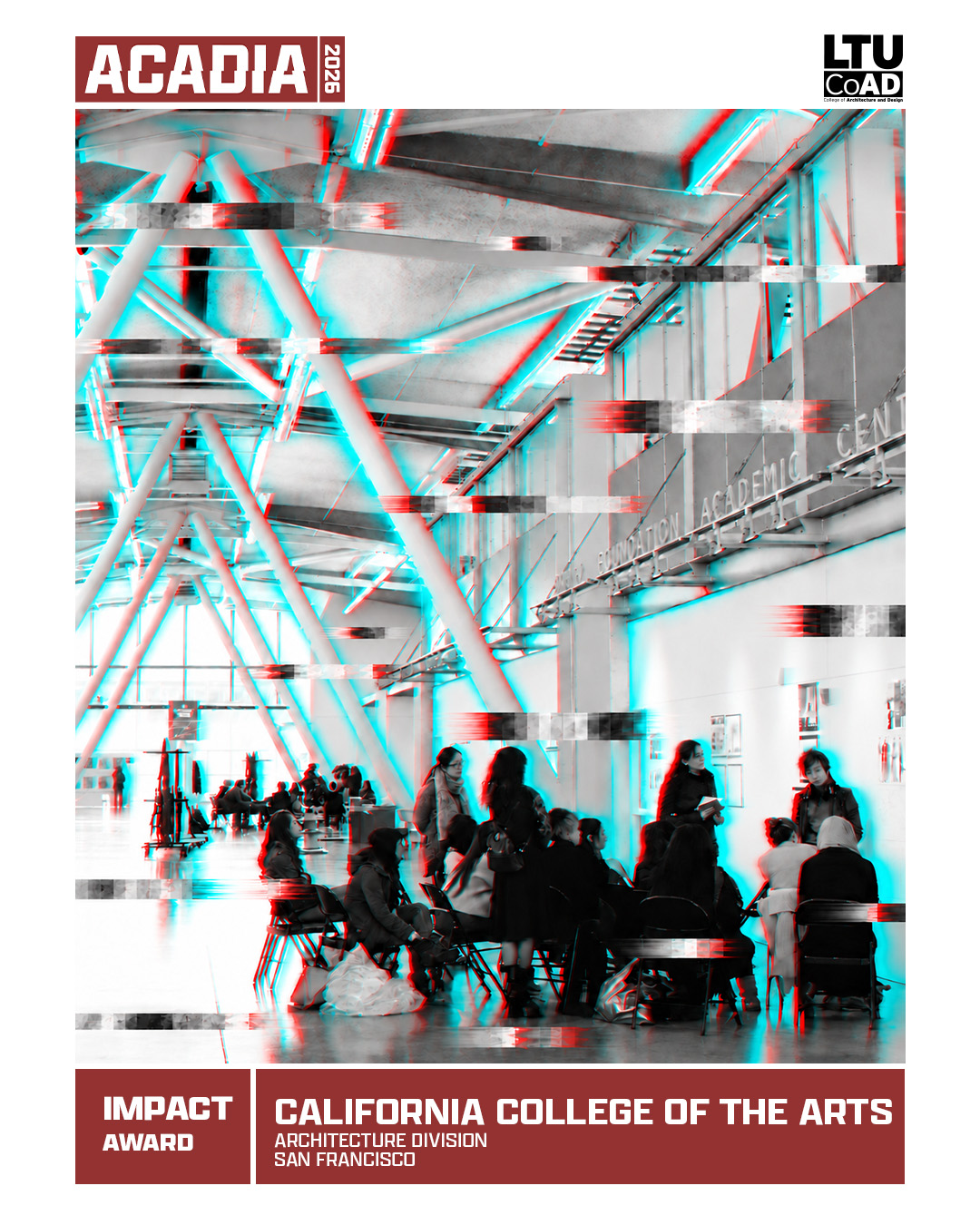
California College of the Arts Architecture Division
California College of the Arts Architecture Division
For decades, CCA Architecture has helped shape computational design through an experimental culture connecting design, computation, fabrication, material research, emerging technologies, and empathetic built environments. Its contributions include hosting ACADIA 2012, the work of the Digital Craft Lab and Architectural Ecologies Lab, and influential teaching, research, and creative practice by a long list of influential faculty members.
Across generations of faculty, students, and alumni, CCA has maintained a deep relationship with ACADIA as authors, presenters, reviewers, board members, conference organizers, and participants. Their contributions have extended computational design into new questions of craft, material systems, robotics, ecology, representation, and architectural production.
The award recognizes this collective legacy and the lasting influence of CCA Architecture on generations of designers, educators, researchers, and practitioners working across computational design.