Call for Submissions
The conference peer-review process is organized around calls for full papers, projects, and field notes. Full papers present original research, methodologies, and theoretical frameworks that advance discourse on computation, making, and cultural practices. Project presentations focus on built work, speculative prototypes, and experimental workflows that connect technology with design culture. Field notes provide concise reflections, critical provocations, and in-progress investigations that document emerging practices.
Conference Theme: Humanism Recoded
We propose a curated set of subthemes that extend the conference theme into specific areas of inquiry and frame the call for submissions, including:
- Machines that Care — Robotics and autonomous systems reimagined as partners in repair, care, and cultural making.
- Embodied Codes — Computation situated in bodies, practices, and local contexts.
- Algorithmic Fictions — AI as narrator, collaborator, and storyteller of shared futures.
- Humanistic Inquiries — Critical perspectives on computation, making, and cultural practice.
- Material Worlds — Circular systems, craft traditions, and experimental fabrication.
- Eco-Digital Fusion — Living materials and synthetic ecologies in design workflows.
- Collective Intelligence — Shared authorship across humans, machines, and communities.
- Digital Commons — Technology as infrastructure for equity and participation.
- Built Grounds — Architecture as a site of making, use, and collective life.
- Temporal Layers — Design and heritage in dialogue with history and memory.
- Speculative Grounds — Design fictions, non-linear worlds, and cultural imaginaries.
- Climate Matters — Computation and making within planetary urgencies.
ACADIA 2026 invites research contributions across, but not limited to, the following areas. Submissions may also engage hybrid approaches that cut across multiple domains:
Artificial Intelligence and AI-driven Design | Augmented Reality and Simulation | Autonomy and Human Agency | Biodesign and Climate Responsive Architecture | Computational Design | Data Capture and Sensing | Design-build and Construction | Digital Fabrication | Ethics and Data Practices | Human-Computer Interaction and Human-Robot Interaction | Material Computation | Pedagogies and Philosophies | Robotics and Automation | Simulation, Predictive Modeling | Spatial Computing and Extended Reality | Theory and Cultural Frameworks
SUBMISSION INFORMATION AND DEADLINES (EasyChair Portal now open for submissions)
1. Full Papers
Full Papers should present original work embedded within substantial research or creative practice. Submissions may include research-based projects, theoretical papers, design workflows, and/or innovative techniques and methods that advance the field of computational design.
Submission Requirements: Full papers (4,000 words) are invited for submission. All paper submissions are subject to blind peer review. Accepted papers will be published in the conference proceedings, and authors will be invited to present at the conference. Published papers will be included in the CumInCad database and assigned a DOI. All ACADIA papers are searchable through Web of Science Platform and Scopus. Please refer to ACADIA’s Publication Ethics Guidelines for detailed policies regarding academic writing, originality, plagiarism, intellectual property, and the peer review process.
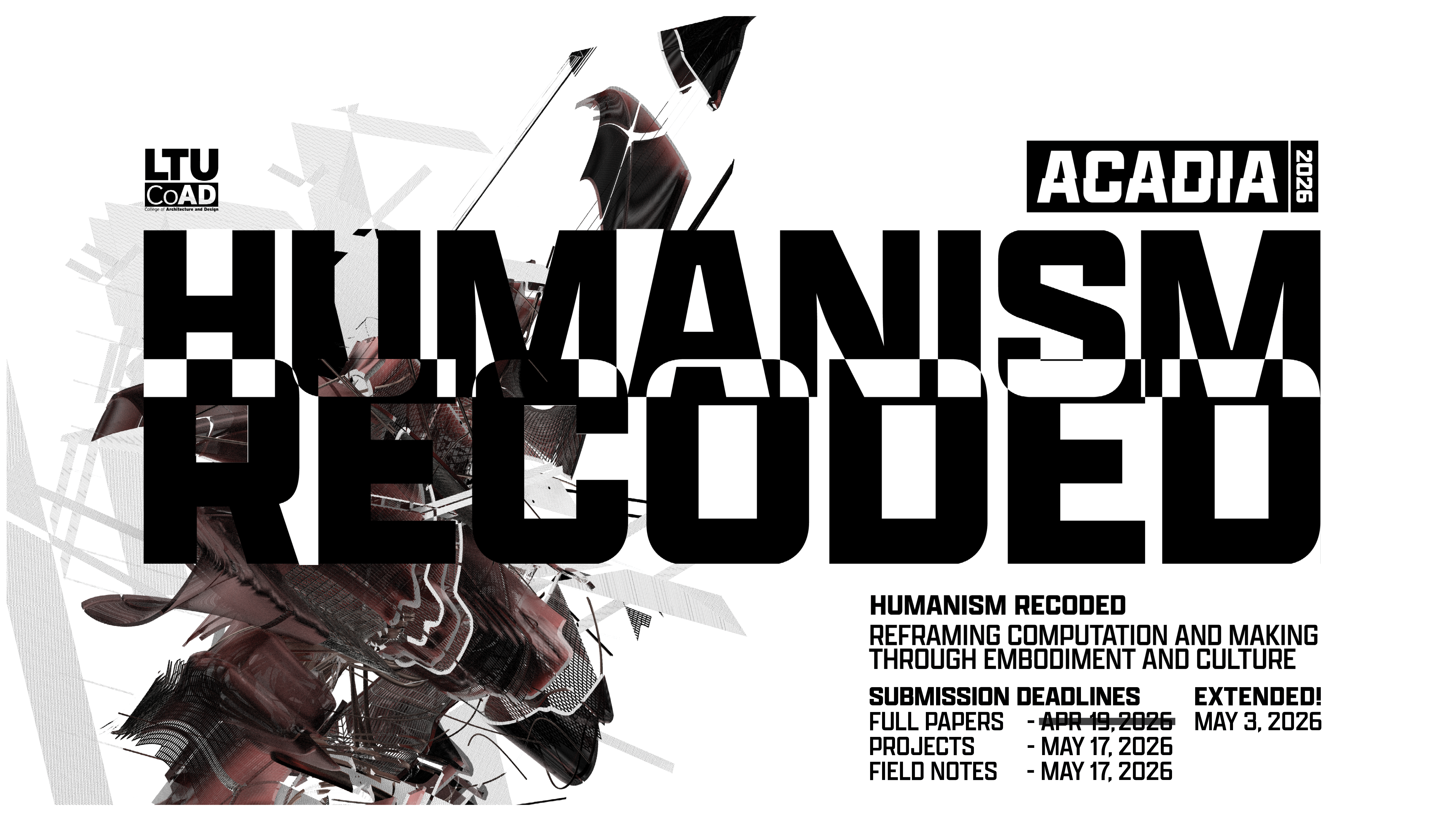
Deadline: April 19 May 3 (EXTENDED!), 2026, 11:59 pm AoE (Anywhere on Earth)
Notification of Acceptance: May 2026
Revised Papers Due: June 2026
Please use the ACADIA 2026 Full Papers Style Guide for formatting your submission, and review the Paper/Project Submission Guidelines, the ACADIA Collaborative Authorship Policies, and the ACADIA Artificial Intelligence Guidelines prior to submitting your work.
Submit your paper: EasyChair Submission Portal
2023 & 2024 Best Paper samples
2. Projects
Built work, speculative prototypes, installations, or experimental workflows demonstrating the integration of computational tools with material, cultural, or social contexts.
Submission Requirements: 600-word text (excluding citations and captions) plus a maximum of 10 images.
Details: Project submissions will be blind peer-reviewed. Projects will be published in the conference proceedings and exhibited as posters in the Exhibition, and authors will be invited to present at the conference. Published projects will be included in the CumInCad database and assigned a DOI. All ACADIA projects are searchable through Web of Science Platform and Scopus. Please refer to ACADIA’s Publication Ethics Guidelines for detailed policies regarding academic writing, originality, plagiarism, intellectual property, and the peer review process.
Deadline: May 17, 2026, AoE (Anywhere on Earth)
Notification of Acceptance: June 2026
Revised Papers Due: July 2026
Please use the ACADIA 2026 Projects Style Guide for formatting your submission, and review the Paper/Project Submission Guidelines, the ACADIA Collaborative Authorship Policies, and the ACADIA Artificial Intelligence Guidelines prior to submitting your work.
Submit your project: EasyChair Submission Portal
2023 & 2024 Best Project samples
3. Field Notes
Short-form submissions offering critical provocations, in-progress research, reflective observations, or emerging practices that engage computation through situated, experimental, or exploratory approaches.
Submission Requirements: 800–1,000 word texts max; images are permitted, and image-based essays are also welcome.
Details: Field Notes are an invitation for shorter pieces that may include provocative artifacts regarding the culture and practice of computational design: experimental ideas, behind-the-scenes observations, brief narratives, provocations, and manifestos. Submissions will be jury-selected and published in the proceedings, and authors will be invited to present at the conference.
Deadline: May 17, 2026, AoE (Anywhere on Earth)
Notification of Acceptance: June 2026
Revised Papers Due: July 2026
Please use the ACADIA 2026 Field Notes Style Guide for formatting your submission, and review the Paper/Project Submission Guidelines, the ACADIA Collaborative Authorship Policies, and the ACADIA Artificial Intelligence Guidelines prior to submitting your work.
Submit your Field Notes: EasyChair Submission Portal
2023 & 2024 Field Notes samples
REVIEW PROCESS
All submissions will undergo a double-blind peer review process coordinated by the Technical Chairs and Project Chairs in accordance with ACADIA standards. Submissions will be evaluated based on originality, rigor, relevance to the conference theme, and contribution to computational design research and practice.